
Understanding Your Options
When you lose one or more teeth, replacing them is not just a cosmetic concern — it affects how you chew, how you speak, and the long-term health of your jawbone and surrounding teeth. Two of the most reliable solutions available today are the traditional dental bridge and the implant-supported bridge. Both restore the appearance and function of missing teeth, but they work in fundamentally different ways, and the right choice depends on your specific clinical situation, bone health, budget, and long-term goals.
This guide breaks down exactly how each option works, what the treatment process involves, and what you can realistically expect from each over time.
What Is a Traditional Dental Bridge?
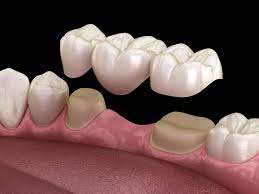
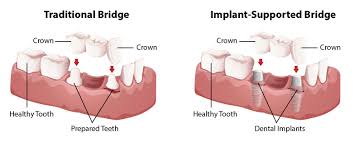
A traditional bridge fills the gap left by one or more missing teeth by anchoring an artificial tooth called a pontic to the natural teeth on either side of the gap. These anchor teeth, called abutments, are filed down and crowned to support the bridge structure.
The result is a fixed, non-removable restoration that looks and functions like natural teeth. Once cemented in place, a traditional bridge cannot be taken out and is cleaned in the same way as natural teeth, with the addition of special flossing tools to clean underneath the pontic.
How the procedure works
The process typically takes two to three appointments over the course of two to four weeks. At the first visit, the abutment teeth are prepared by removing a layer of enamel to make room for the crowns. Impressions are taken and sent to a dental lab where the bridge is fabricated. A temporary bridge is placed in the meantime. At the final appointment, the permanent bridge is cemented into place and adjusted for fit and bite.
What Is an Implant-Supported Bridge?
An implant-supported bridge serves the same purpose replacing one or more missing teeth but instead of relying on adjacent natural teeth for support, it is anchored to titanium implant posts that are surgically placed directly into the jawbone.
For a single missing tooth, one implant supports one crown. For multiple missing teeth in a row, two implants can support a bridge of three or more teeth without involving any natural teeth at all. The implants fuse with the surrounding bone through a process called osseointegration, creating a stable, permanent foundation that functions like natural tooth roots.
How the procedure works
The process is longer than a traditional bridge. After a thorough evaluation including X-rays or a CBCT scan, the implant posts are surgically placed under local anesthesia. A healing period of three to six months follows, during which the implants integrate with the bone. Once fully healed, abutment connectors and the final bridge are placed. The total treatment timeline typically ranges from four to eight months depending on healing and bone density.
Key Differences Side by Side
Impact on adjacent teeth This is one of the most significant distinctions between the two options. A traditional bridge requires the permanent alteration of two healthy neighboring teeth their enamel is removed and they are crowned for life. An implant-supported bridge leaves adjacent teeth completely untouched. For patients with healthy neighboring teeth, this is a compelling reason to consider implants.
Bone health When a tooth is lost, the jawbone in that area begins to shrink over time because it no longer receives stimulation from a tooth root. A traditional bridge replaces the visible tooth but does nothing to address this bone loss. Implants, by contrast, function as artificial roots and actively stimulate the bone, preventing the bone shrinkage that occurs with tooth loss. Over a period of years, this difference becomes visible patients with bridges may develop a slight sunken appearance at the site of the missing tooth, while implant patients maintain their natural facial contour.
Durability and lifespan A well-maintained traditional bridge typically lasts ten to fifteen years before it may need replacement. Implants, when properly placed and maintained, can last twenty to thirty years or longer — many last a lifetime. The crowns or bridge attached to the implants may need replacement over time, but the implant posts themselves are highly durable.
Maintenance Traditional bridges require specialized flossing under the pontic using floss threaders or water flossers, but are otherwise maintained like natural teeth. Implant-supported bridges are cleaned very similarly to natural teeth regular brushing and flossing without the need for special threading techniques.
Treatment time A traditional bridge can be completed in a few weeks. An implant-supported bridge requires several months to allow for proper osseointegration. For patients who need a faster solution, the traditional bridge has a clear advantage in timeline.
Cost Traditional bridges have a lower upfront cost than implant-supported bridges. However, when factoring in the likelihood of replacement over a lifetime, and the potential costs of treating bone loss or damage to abutment teeth down the line, implants are often the more cost-effective solution over the long term.
Which Option Is Right for You?
Neither option is universally better the right choice depends on your individual circumstances. Here is a general framework to guide the conversation with your dentist:
A traditional bridge may be the better fit if you need a faster solution, have a limited budget, do not have sufficient bone density for implants without grafting, or if the teeth adjacent to the gap already need crowns anyway.
An implant-supported bridge is likely the stronger long-term investment if your adjacent teeth are healthy and you want to preserve them, if you are concerned about long-term bone health, if you want the most durable and natural-feeling restoration available, or if you are planning for a solution that will last decades rather than years.
Your dentist will also evaluate factors such as your overall oral health, gum condition, medical history, and bone volume before making a clinical recommendation.
Frequently Asked Questions
1. Can anyone get a dental implant, or are there restrictions?
Most healthy adults are candidates for dental implants. However, sufficient bone density is required to support the implant post. Patients who have experienced significant bone loss due to prolonged tooth absence, gum disease, or other factors may require a bone graft procedure before implant placement is possible. Certain medical conditions and medications can also affect candidacy, which is why a thorough consultation and imaging are always the first step.
2. Is the implant surgery painful?
The procedure is performed under local anesthesia, so you should not feel pain during the surgery itself. Some soreness, swelling, and mild discomfort in the days following the procedure is normal and manageable with over-the-counter pain relief. Most patients find the recovery more comfortable than they anticipated.
3. What happens to the bone under a traditional bridge over time?
Without a tooth root or implant to stimulate it, the bone beneath the gap gradually resorbs — meaning it shrinks in volume. Over years, this can lead to a slight indentation or sunken appearance at the site and may affect the fit of the bridge over time. This is one of the primary clinical arguments for implants when long-term bone health is a priority.
4. If I start with a traditional bridge, can I switch to an implant later?
In principle, yes, but it becomes more complicated over time. Bone loss at the gap site may require grafting before an implant can be placed. The abutment teeth that were crowned for the bridge will remain crowned regardless. If implants are something you may want in the future, discussing this with your dentist before committing to a bridge is worthwhile, as it may influence the recommendation.
“Whether a traditional bridge or an implant-supported solution is right for you, our team will take the time to walk you through every option clearly and honestly — because the best treatment is always the one that fits your life, not just the gap in your smile.”